



New startups based on AI technology are currently emerging almost every day. Whether their business ideas are good or not I'll let time tell, but to me it's obvious that tech companies that don't have some form of AI in their tool belt will soon be as outdated as those that still use typewriters. For our use, at least, I see the obvious place in an extension of where GitHub's Copilot operates. If someone should have been asked to implement FizzBuzz in an interview and had spent more than ten seconds, for example "Create a fizzbuzz implementation in typescript" in ChatGPT, or "function fizzbuzz", tab, tab, tab, until done with Copilot, they show that they are wasting everyone's time. The same applies to all other school examples of algorithms and coding tasks.

So we now know that ChatGPT can help us with trivial programming jobs, the kind where most experienced developers know in advance what the solution is going to look like. Fortunately, the projects we solve are quite a bit more complex than that. What can be seen, however, is that some of them may resemble each other on a superficial level in terms of modeling and functional requirements. Should you have a system to manage users, groups of users, locations and goods that flow between locations? Do you need a system that will compile information from three different external sources, transform the data and present it in an API? This sounds like something someone has made before. Why then create it again, if you can describe it on a higher level and let an AI service write the code for you? In a few years, not to mention months, I imagine that you can slap in a description of the system you want with a couple of sentences, and seconds later you have the first prototype, written in the language and framework you have chosen, running in the cloud service you prefer. If things don't go right in the first round, you can give some friendly pointers in the right direction and try again.
Many pieces of this puzzle have been around for a while. I remember the first time I saw a demonstration of Spring Roo, a CLI tool built on Java and Spring where you could specify the names, fields and relationships of the entities in the model you want, and it will scaffold up an entire system for you based on these. At the time it was impressive and a good starting point for a smaller project, but also limited in what it was able to create for you. If you needed something more than what the narrow design and relational models allowed, you had to make it yourself. This type of tool will sooner or later use the AI tools' properties to derive larger contexts and text based on the user's input. If, for example, you ask such a tool for a digital marketplace where people can buy and sell some product or service, it will have seen enough such systems to create something that is both reminiscent of already existing services. At the same time, it will adapt the solution for your personal twist or target group. Although this is only a fantasy today, it is our job to stay up-to-date on what opportunities we have today and tomorrow.
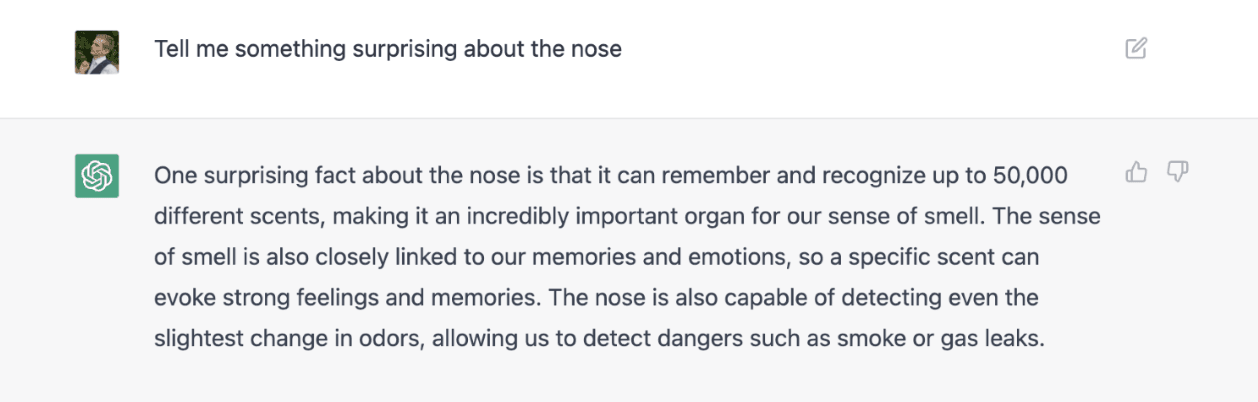
All this I expect is familiar, especially if you have already turned your head in the hope of finding a glimmer of hope for your own business in the coming years. I won't claim deep expertise, but my hope, no, my prediction, is that the job of a developer will take a turn towards more fun and interesting tasks if we first open our arms to these new tools. There are many things AIs are good at, but there are a number of areas where humans are still superior: Imagination, surprise and interest are some of them. ChatGPT can tell you in detail about any part of the body you can name, but if you ask it to tell you something it finds interesting or surprising about the body, it won't have a clue. Because what is actually a fun fun fact that most people don't know, and what is common knowledge? An AI is unable to distinguish this, because for it (for the time being) a fact is only a fact. Unless it is only something it has made up, which it also has an ugly tendency to do relatively uncritically.
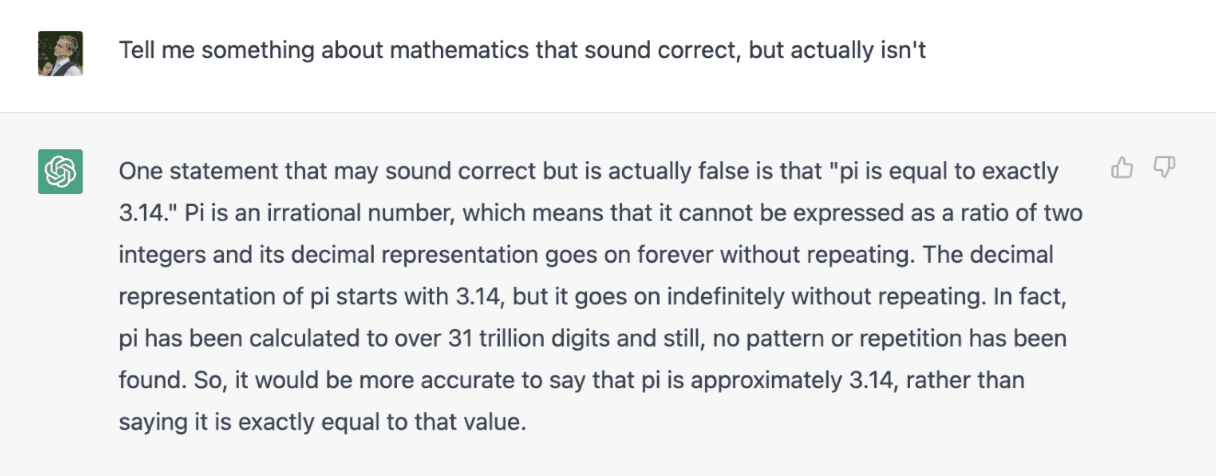
And if you lean on this tendency to invent false things and ask it to make up a statement that seems plausible but isn't, at best it can tell you things like "Pi is exactly 3.14", which is neither particularly made up nor plausible. It's just inaccurate and wrong, and obviously so. So the previously mentioned basic human qualities such as imagination, interest and surprise are not particularly good at today's text generators.
So what does this mean for us? When I look at new projects, I tend to look forward to the areas where we move into more unknown waters. Where developers, designers and users may have to test different approaches, where we explore the possibilities for what we can achieve with the available data, where we experiment with creative solutions, untested tools and where through the process you find out new things. Through this, we get the opportunity to create something completely new, and together think thoughts that no one has thought of before. It's just a shame that many projects end before getting to, or nowhere near through, this phase.
You like to dream there in the start-up, but time, money and priorities go another way while you work your way through yet another system where you have to extract some data from a database, filter based on personalisation, put on some make-up, and finally present it to the user. Imagine how much fun it would be if you could avoid taking this whole detour, but instead use your energy on the difficult problems? Outline some models, interactions, design prototypes, feed this to an AI tool and for the first demo present a production-ready system that solves the customer's immediate needs. A system written with documented, readable, testable, maintainable code, ready for further development. A good foundation for attacking the exciting and unknown.
This is what makes me optimistic about the future of developers. The vast majority of people I have worked with are smart, creative people who are driven to push the boundaries of what is technically possible. Over the years, we have further developed the tools, from punch cards with CPU instructions to high-level programming languages, from reading single bits on magnetic tape, to globally accessible real-time databases. In that sense, it is perhaps only the natural solution that the future will be even more high-level than today. With the combined knowledge from thousands of projects, millions of lines of code, we will hopefully in the future be able to focus energy and brain capacity on rather finding the unique and innovative approaches.
Because unlike an artificial intelligence, I AM actually interested. I AM curious about what I can achieve and how to solve a problem no one has solved before me. That's what's fun about the job I've chosen. And precisely the fact that this could be my future makes me optimistic about using AI in the future. Not to outdo me, but to do what I could have done but didn't bother. I no longer write on a typewriter, and have appliances that take care of the dishes and heat management. And I let ChatGPT write fizzbuzz for me.


