





Basics of app development
What is an app?
An app, or application, is a software product designed to run on mobile devices such as smartphones and tablets. Apps can vary from simple tools to complex systems for banking services or social media. The use of apps has increased sharply in recent years, which underlines the importance of a presence in the app market.
Different types of app development
There are mainly three approaches to creating an app:
- Native app development: Apps are built specifically for one platform (iOS or Android) using platform-specific programming languages and tools.
- Cross-platform development: Using frameworks such as Flutter or React Native, developers can write one codebase that runs on several platforms, which often reduces both development time and costs.
- Web apps: Apps that run in browsers and are optimized for mobile devices, often referred to as progressive web apps (PWA).
Why is choosing a platform important?
The choice of development platform affects, among other things:
- Development costs and time
- App performance and user experience
- Maintenance requirements
- Access to platform-specific functions
- Competence requirements for the development team
In a market where efficiency and quality are highly valued, choosing the right platform can be crucial to the success of the project.
Flutter: Google's framework for cross-platform development
Flutter is an open-source UI framework that allows developers to build native-like apps for mobile, web and desktop from a single codebase.
What is Flutter?
Flutter uses the Dart programming language and offers a set of pre-built widgets. Instead of using native UI components, Flutter draws all UI elements with its own rendering engine. This gives developers full control over the look and feel.
Advantages of Flutter
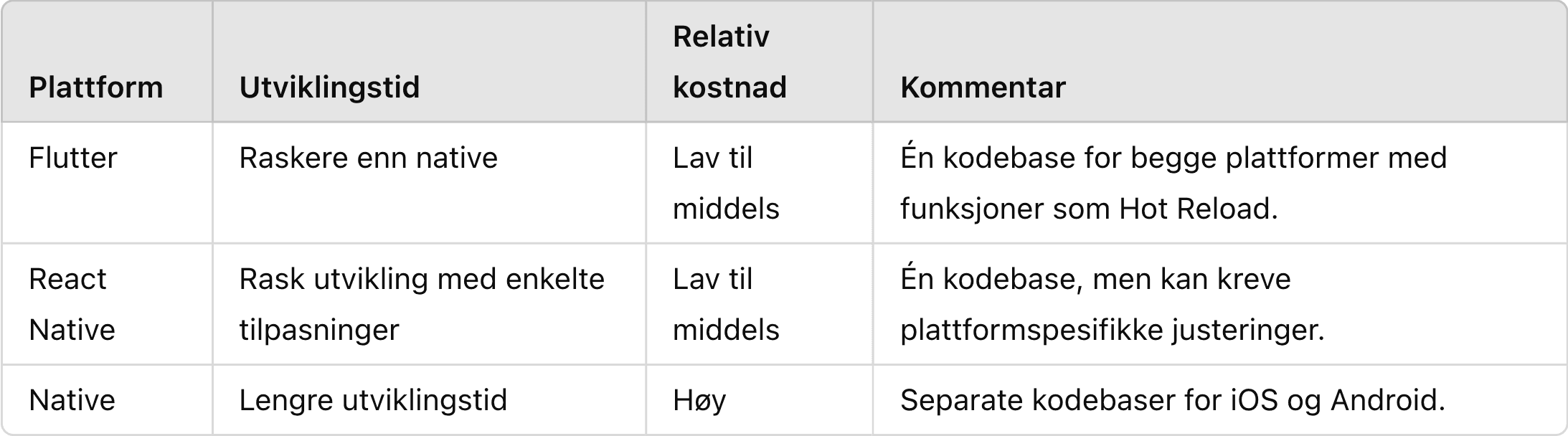
- Fast development with features like Hot Reload.
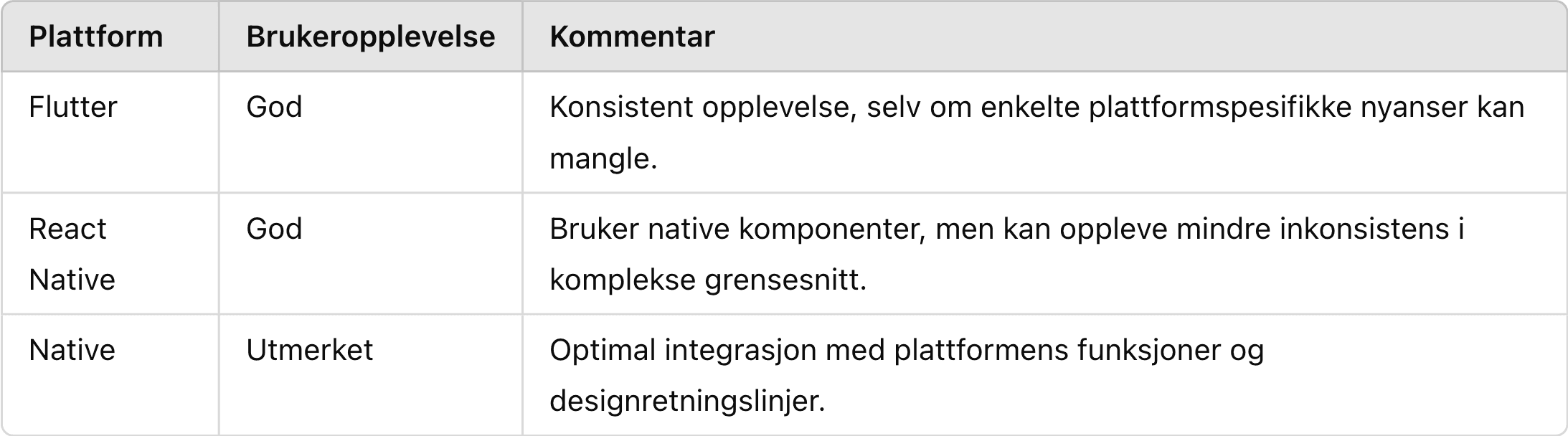
- Consistent user experience across platforms.
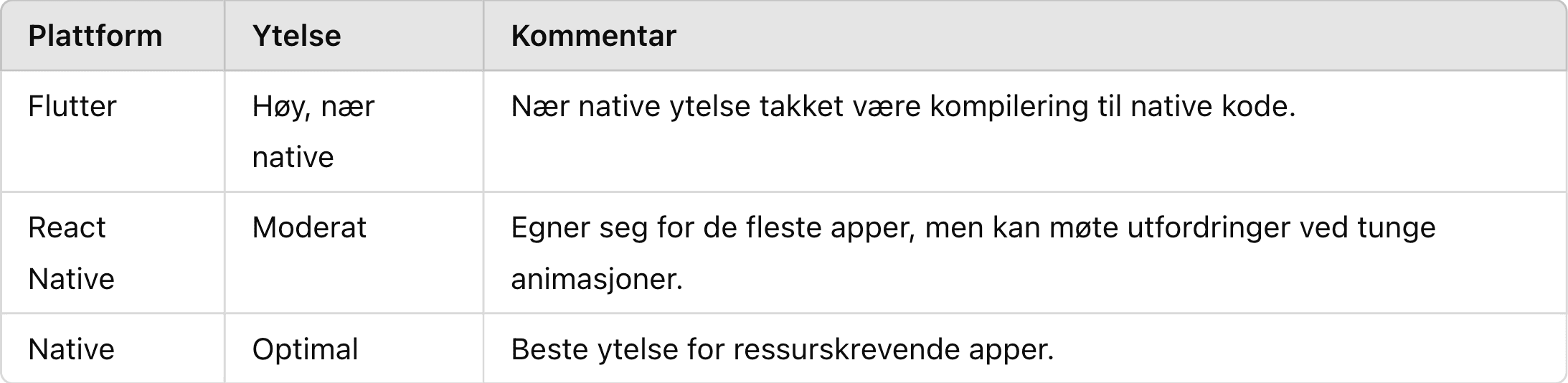
- Near native performance through compilation to native code.
- One code base reduces maintenance costs.
- Support for both web and desktop provides opportunities for extended platform coverage.
Disadvantages of Flutter
- The ecosystem is somewhat young compared to native development.
- Apps may have a slightly larger file size.
- Some advanced features may require additional work with native code.
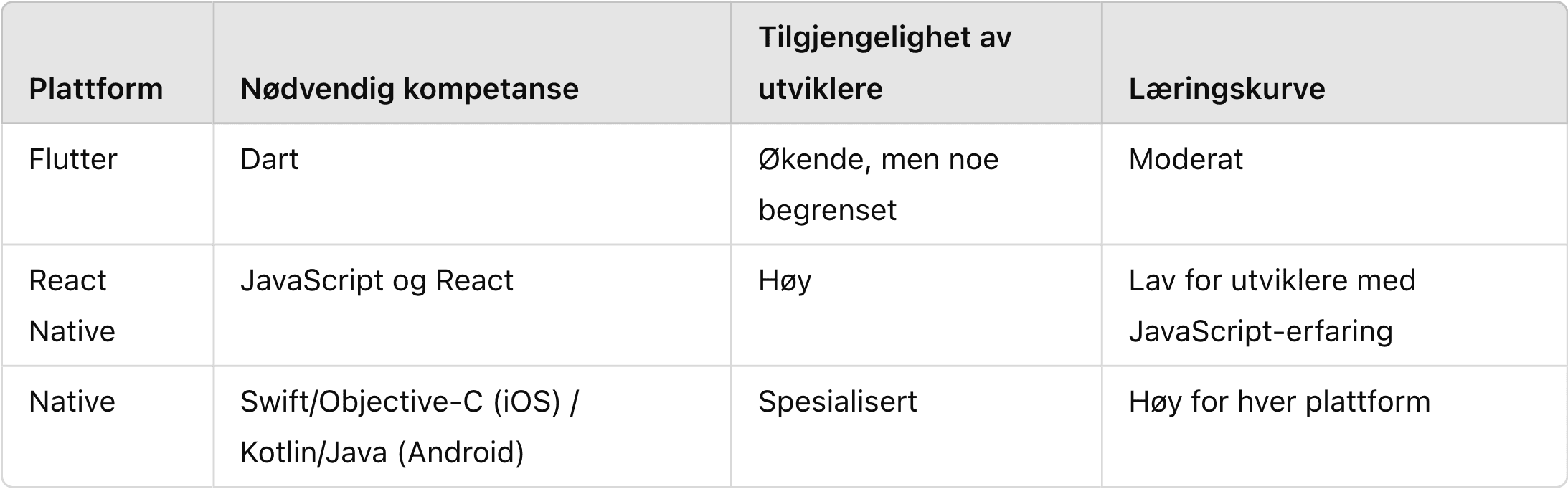
- Developers need to learn Dart, which is less widespread than other languages.
React Native: Facebook's solution for cross-platform development
React Native allows developers to build mobile apps with JavaScript and React, using native UI components to create authentic user experiences.
What is React Native?
React Native combines JavaScript with native components, so developers can reuse much of their web expertise in mobile development. In the legacy architecture, JavaScript communicates with native code through an asynchronous bridge. React Native's New Architecture, enabled by default from version 0.76, uses JSI for direct communication instead.
Advantages of React Native
- A large developer community with widely experienced JavaScript developers.
- Fast iteration with Hot Reloading.
- Sharing of code base for iOS and Android.
- Mature ecosystem with a wide selection of libraries and tools.
Disadvantages of React Native
- Somewhat lower performance than native solutions, especially for complex apps.
- Apps that remain on React Native's legacy bridge architecture can encounter communication bottlenecks between JavaScript and native components.
- Updates and version changes may require additional work.
- Variations in the quality of third-party libraries.
- Less control over detailed pixel-perfect design.
Native app development: Platform-specific approach
Native app development involves developing apps for each platform using respective programming languages and tools.
What is Native app development?
For iOS, apps are developed with Swift or Objective-C, while Android uses Kotlin or Java. This approach provides full access to all the platform's features and optimal performance.
Advantages of Native development
- Best possible performance and responsiveness.
- Direct access to all device APIs and functions.
- The user interface follows platform-specific design guidelines, providing an intuitive experience.
- Early support for new features from the platform providers.
- Effective debugging and testing with tools offered by the platform.
- High security with native tools and mechanisms.
Disadvantages of Native development
- Higher development costs due to separate code bases for each platform.
- Longer development time to implement the same functionality across platforms.
- Increased maintenance costs with separate updates for each platform.
- Requires developers with specific platform expertise, which can be challenging to recruit.
Comparison: Flutter vs React Native vs Native
Performance
Development time and cost
User experience
Competence requirements
Market coverage in Norway
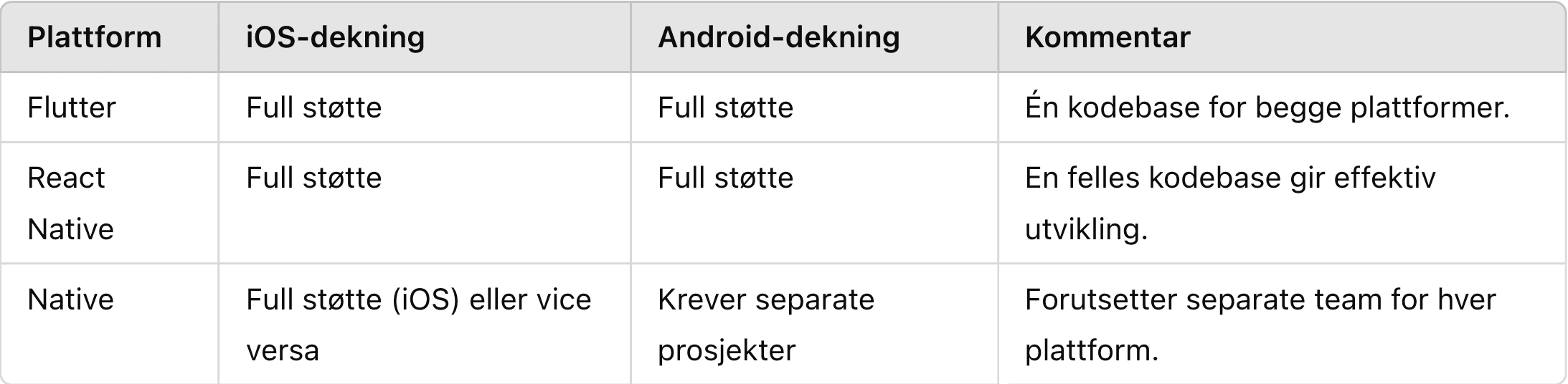
Decision criteria: How to choose the right platform for your app
The choice between Flutter, React Native and native development depends on several factors:
- Project complexity and requirements: Simpler apps can often be built with cross-platform solutions, while apps with high performance requirements and advanced functionality can benefit from native development.
- Budget and timeframe: Cross-platform options can provide faster time-to-market and lower costs, while native development often requires a greater investment in both time and resources.
- Target platforms: If you want to support both iOS and Android, cross-platform development provides a simpler solution, while a one-sided focus may make native development more appropriate.
- The team's expertise: If your team is familiar with JavaScript and React, React Native can be a natural choice. If, on the other hand, you want to utilize specialized mobile development expertise, native development or Flutter may be appropriate alternatives.
- Long-term maintenance: A common codebase for multiple platforms can simplify maintenance, while separate codebases require dedicated teams for each platform.
Future perspectives: Where is app development going?
The app development landscape is constantly changing:
- Flutter: The platform is being developed quickly and is gaining ever wider support. It is designed to be expandable to more platforms in the future.
- React Native: With a mature technology base and a large developer community, React Native remains a popular choice for many.
- Native development: Improvements in the development tools make native development more efficient, and new frameworks help to reduce some of the complexity.
- Hybrid approaches: Many choose a combination of native and cross-platform development to balance performance and development efficiency.
Conclusion: Which platform is best for your company?
The choice between Flutter, React Native and native development depends on the project's goals, requirements and resources.
- Flutter can be ideal if you want a fast and cost-effective solution for several platforms with modern technology.
- React Native is a good choice if your team has strong JavaScript expertise and you want a balanced solution with broad support.
- Native development is best suited when performance, security and optimal user experience are essential, despite higher costs and longer development time.
Regardless of which platform you choose, it is important to have a clear understanding of the project's goals and requirements before the development process is started.
Common questions about app development
How to create an app from scratch?
Start by defining the app's purpose and target group, create a prototype, choose a development platform and build the app. Test thoroughly before launch. The process requires both technical expertise and a deep understanding of user experience.
How much does it cost to develop an app?
Development costs vary based on the app's complexity, design and functionality. In general, a simpler app will be less expensive, while more complex solutions with advanced features require larger investments. It is important to consider both development costs and long-term maintenance costs.
How long does it take to develop an app?
The development time depends on the complexity of the app. Smaller apps can often be developed faster, while larger and more complex applications take longer. Many projects start with a minimum functional version (MVP) to test the market before full-scale development is initiated.
Can I convert my website into an app?
Yes, there are several approaches to converting a website into an app. You can develop a progressive web app (PWA) or use a hybrid framework to integrate the website's functionality into an app.


